


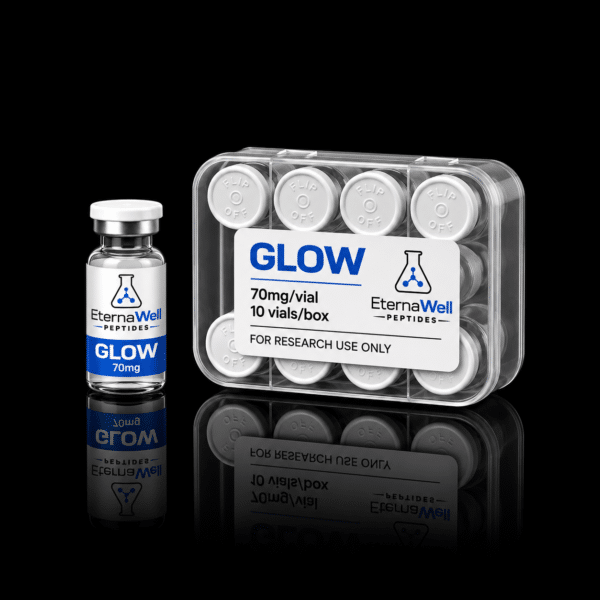
GLOW | Lyophilized Peptide Blend | 70 mg
For In Vitro Research Use Only — Not for Human or Veterinary Use
Specifications
Form: Lyophilized peptide blend
Appearance: Refer to the lot-specific Certificate of Analysis
Container: Research-grade vial
Total Content: 70 mg per vial
Composition: BPC-157 10 mg | TB-500 10 mg | GHK-Cu 50 mg
Solubility: Refer to the supplier’s technical documentation for compatible solvents and laboratory buffers
GLOW — Research Peptide Blend (BPC-157 / TB-500 / GHK-Cu)
Contains:
• BPC-157 — 10 mg
• TB-500 — 10 mg
• GHK-Cu — 50 mg
Class: Multi-component research formulation containing two peptide ingredients and a copper-complexed tripeptide
What Is GLOW?
GLOW is the product name for this combination of BPC-157, TB-500, and GHK-Cu. It is a blend rather than a single peptide, with the three ingredients supplied in a 1:1:5 mass ratio.
BPC-157 is a synthetic 15-amino-acid peptide investigated in experimental models of cellular migration and stress responses. TB-500 is a name associated with thymosin beta-4–related research materials; its exact sequence and molecular identity should be confirmed in the supplier’s documentation. GHK-Cu is the copper complex of the tripeptide glycyl-L-histidyl-L-lysine, studied in fibroblast biology and extracellular-matrix regulation.
The GLOW name does not establish a standardized formulation across suppliers. Research findings for individual ingredients do not establish the activity, compatibility, or effectiveness of this combined blend.
Research Focus (non-clinical):
• Cellular migration, adhesion, and cytoskeletal organization
• Fibroblast responses and extracellular-matrix regulation
• Collagen-synthesis markers in cultured-cell models
• Cellular responses to experimental stress conditions
• Comparative evaluation of individual ingredients and the combined formulation
Notes for Investigators:
GLOW combines ingredients with distinct areas of laboratory investigation. Published BPC-157 research includes studies of tendon-fibroblast migration and FAK–paxillin signaling. Research on thymosin beta-4 and related fragments examines cytoskeletal interactions and cellular migration, with findings dependent on the specific molecule tested. GHK-Cu has been investigated in fibroblast cultures for effects on collagen synthesis and associated signaling.
Studies using this blend should account for ingredient identity, individual concentrations, formulation stability, and assay compatibility. Synergistic effects should not be assumed; appropriate single-ingredient and vehicle controls are needed to evaluate interactions within the formulation.
Regulatory & Use:
Laboratory research only. Not for human or veterinary use. Intended strictly for in vitro research applications.
Storage
- Follow the supplier’s lot-specific storage temperature and stability guidance for the complete blend.
- Protect from excessive heat, moisture, and direct light.
- Keep the vial tightly sealed until use.
- Follow validated laboratory protocols for storage after reconstitution.
- Avoid repeated freeze-thaw cycles unless supported by product-specific stability data.
Legal Disclaimer
FOR RESEARCH USE ONLY (RUO). NOT FOR HUMAN OR VETERINARY USE.
This product is intended solely for laboratory research by qualified professionals. It is not intended for human or veterinary use, clinical applications, food production, cosmetic use, or dietary supplements.
No claims are made regarding the diagnosis, treatment, cure, or prevention of any disease. Research-use labeling does not establish FDA approval or authorization for clinical use.
Terms of Sale
By purchasing this product, the buyer certifies that they are a qualified researcher or authorized institution and assumes full responsibility for the handling, storage, transportation, and lawful use of this material. All products are sold strictly for legitimate laboratory research purposes. All sales are final.
Reviews
There are no reviews yet.