



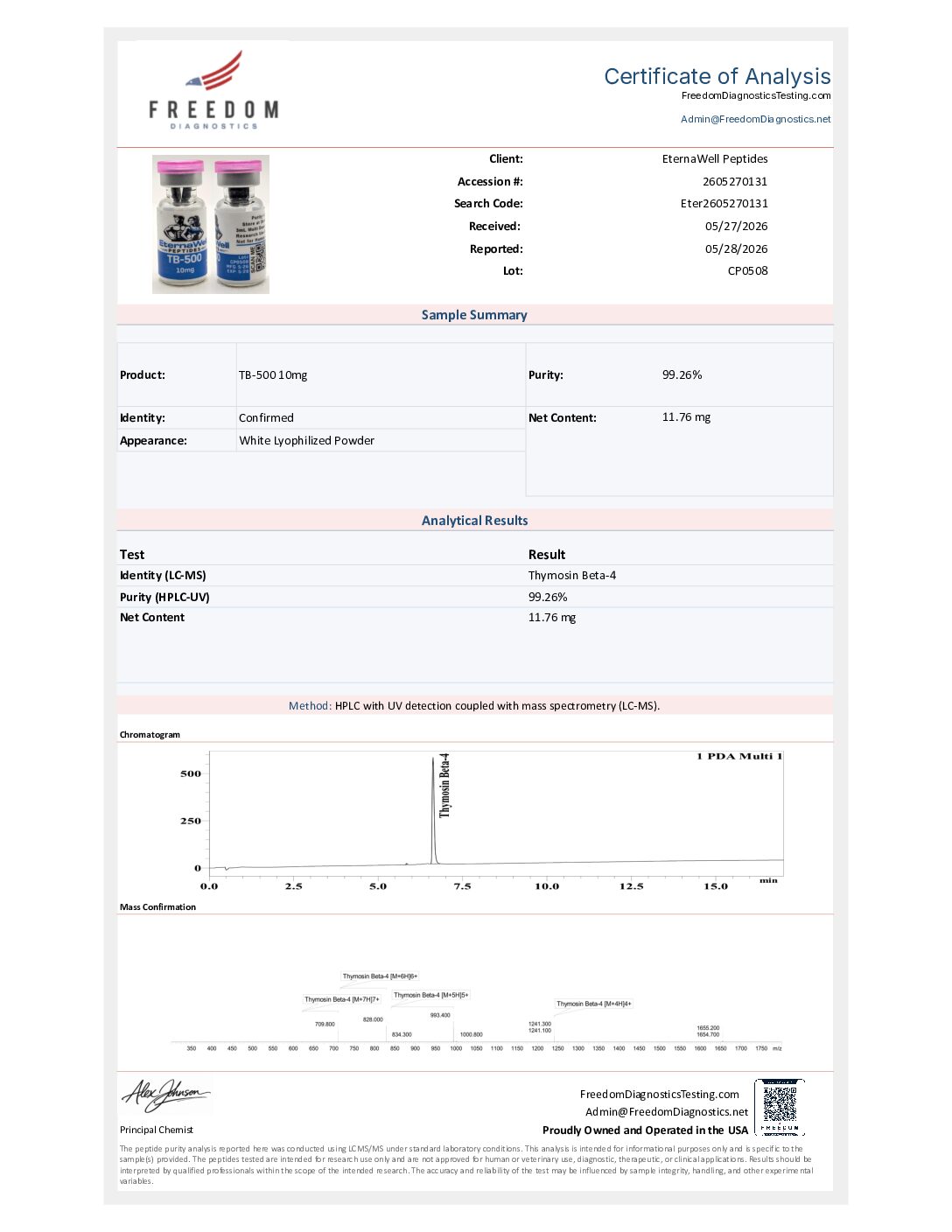
TB-500 10mg — Research Peptide
Contains:
• TB-500 10mg
Class: Synthetic peptide fragment studied in cellular migration signaling pathways, tissue-repair mechanisms, angiogenesis models, and regenerative-response research
────────────────────────
Research Focus (non-clinical):
• Cell migration and actin-regulation pathway activity in experimental models
• Tissue-repair and wound-healing signaling investigations in laboratory settings
• Angiogenesis-related pathway interactions and vascular-response studies
• Inflammatory-response modulation and cytokine signaling research
• Musculoskeletal and connective-tissue recovery pathway analysis
• Extracellular matrix interaction and cellular differentiation studies
────────────────────────
Notes for Investigators:
TB-500 is a synthetic research peptide modeled after an active region associated with thymosin beta-4 activity. In laboratory research environments, TB-500 is commonly investigated for its involvement in cellular migration, tissue remodeling, angiogenesis signaling, and regenerative-response mechanisms.
Preclinical models frequently examine TB-500’s influence on actin-binding interactions and cellular structural dynamics associated with tissue repair processes. Researchers also investigate its effects on inflammatory signaling pathways, connective tissue response mechanisms, vascular-development activity, and coordinated recovery signaling under controlled experimental conditions.
Its broad involvement in cellular communication and regenerative pathway signaling has made TB-500 a subject of interest in studies focused on musculoskeletal recovery models, tissue-response mechanisms, angiogenesis investigations, and connective-tissue research applications.
TB-500 provides a high-concentration, single-vial format for researchers investigating regenerative signaling systems and tissue-repair pathway interactions in controlled preclinical and in vitro laboratory settings.
────────────────────────
Regulatory & Use:
Laboratory research only. Not for human or veterinary use. Intended strictly for in vitro and preclinical research applications.
Reviews
There are no reviews yet.